Add your promotional text...

Essential Oil -Bitter Almonds
Discover the fascinating history and unique properties of Bitter Almond essential oil, valued for its distinctive aroma and specialized industrial uses.
ESSENTIAL OIL
7/4/20262 min read
Essential Oil – Bitter Almond
Botanical Information
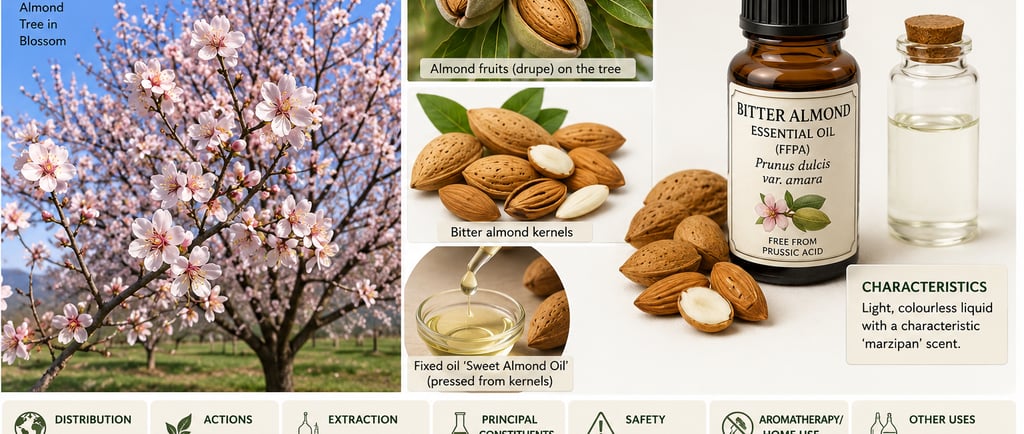
Bitter almond (Prunus dulcis var. amara) belongs to the Rosaceae family and is a medium-sized tree that grows to approximately 7 metres in height. It is admired for its attractive pinkish-white blossoms and is botanically classified as a drupe. The plant is also known by several scientific synonyms, including Prunus amygdalus var. amara, Amygdalus communis var. amara, Amygdalus dulcis, and Prunus communis. There are two main varieties of almond trees: bitter almond and sweet almond. Unlike the bitter variety, the sweet almond does not produce essential oil.
Distribution and Traditional Uses
Bitter almond is native to Western Asia and North Africa but is now widely cultivated throughout the Mediterranean region, Israel, and California. Traditionally, both bitter and sweet almond kernels are pressed to produce a fixed oil known as sweet almond oil. Unlike bitter almond essential oil, this fixed oil does not contain benzaldehyde or prussic acid, making it safe for medicinal and cosmetic applications. It has long been used to relieve constipation, bronchitis, coughs, heartburn, and disorders affecting the kidneys, bladder, and bile ducts. It is also valued for soothing muscle aches, softening the skin, and promoting a healthy complexion.
Essential Oil and Characteristics
Bitter almond essential oil is obtained through steam distillation of the almond kernels. Before distillation, the kernels are pressed and soaked in warm water for 12 to 24 hours. During this process, prussic acid is formed, although it is absent in the raw seeds. Most commercially available bitter almond essential oil is purified to remove prussic acid and is sold as FFPA (Free From Prussic Acid). The resulting oil is a light, colourless liquid with a distinctive sweet marzipan-like aroma.
Chemical Composition
The major constituent of bitter almond essential oil is benzaldehyde, which accounts for approximately 95% of its composition and gives the oil its characteristic almond fragrance. The remaining composition includes about 3% prussic acid (hydrocyanic acid or cyanide), along with trace amounts of other naturally occurring compounds.
Therapeutic Properties
Traditionally, bitter almond essential oil has been described as having anaesthetic, antispasmodic, narcotic, and vermifuge (anti-parasitic) properties. However, because of its toxic chemical constituents, it is not considered suitable for therapeutic or aromatherapy use.
Safety and Precautions
Bitter almond essential oil should not be used internally or externally for therapeutic purposes. Prussic acid, also known as hydrocyanic acid or cyanide, is highly poisonous, while benzaldehyde is moderately toxic. Although commercial oils are usually purified to remove prussic acid, the oil should still be handled with caution and is generally not recommended for aromatherapy or home use.
Industrial Uses
Today, bitter almond essential oil is no longer used as an internal medicine. Rectified bitter almond oil that is free from prussic acid is mainly used as a flavouring agent in confectionery products, particularly for almond essence and marzipan. However, its use has gradually declined as synthetic benzaldehyde has become the preferred alternative in the food flavouring industry.